

Request Pricing
9257f6a2037ee6c574b12d93ac88fad3b951fb8d (1)

End-to-End Building Product Procurement: What Your Import Partner Manages

Key Takeaways
  • Managed procurement works best when the product scope, quantities, decision-makers and programme are reasonably clear.
  • Factories can only provide comparable quotations when they receive the same drawings, finishes, quantities and delivery assumptions.
  • Samples, drawings and finishes should be approved before production, with every later change assessed for cost and timing.
  • Quality control checks the agreed product, while regulatory evidence depends on the exact item and intended use.
  • Freight, customs, local delivery, unloading and storage need to be planned as one coordinated sequence.
  • YIP coordinates the agreed supply and logistics process, while the client team retains design, site and installation responsibilities.

Importing products is rarely difficult because a factory cannot make an item. The difficult part is keeping the project brief, product approvals, factory production, border requirements and delivery programme aligned when they sit with different people in different countries.

For builders, developers, designers and qualified owner-builders, that coordination can involve several fixtures, finishes and made-to-order product categories in one project. Each category has its own drawings, finishes, packing needs and lead times. A low unit price does not resolve those decisions. It can leave the project team with more of them.

YIP provides a managed product sourcing and logistics service for Australian building and renovation projects. The service coordinates the agreed supply chain around an approved product scope. It is not a building contract, installation service, retail shopfront or freight-only booking service.

This guide explains what YIP can coordinate, what the client team still needs to decide, and where a project should pause for approval before the next commitment is made.

Scope note: In this article, building products means selected fixtures, finishes and made-to-order products within YIP’s sourcing scope. YIP provides products and logistics services, not construction or installation.

Who a managed procurement service suits

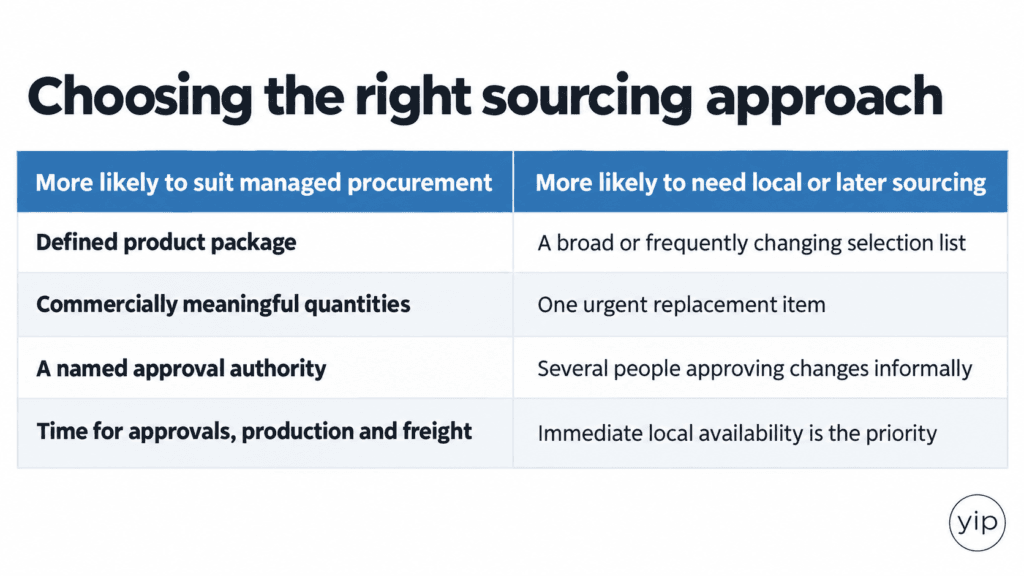
Managed procurement suits a project with enough defined scope to compare and coordinate, and enough purchasing across one or more categories to justify a planned supply programme. The client does not need to know every factory at the outset. The project does need a reasonably clear brief, someone authorised to approve selections and drawings, and a realistic view of the site programme.

It becomes particularly useful when products affect one another. In a kitchen, cabinet dimensions influence appliance openings, benchtop cut-outs depend on the final sink and cooktop information, and the installation sequence depends on the cabinetry arriving complete. Buying each item separately can work, but someone still has to reconcile those connections.

Projects are a poor fit when the scope remains a collection of ideas, quantities change each week or the client needs an item immediately from local stock. A factory order requires approvals and production time. It should not be treated as a last-minute substitute for a missing local product.

Start with scope and specification, not a supplier search

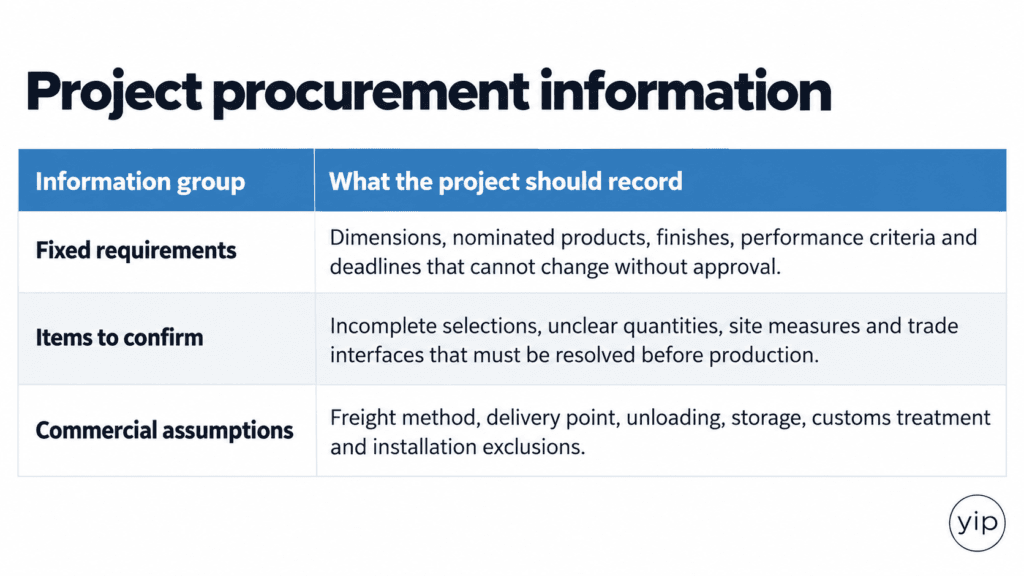
A supplier comparison is only as useful as the brief it compares. Before factories are approached, the procurement scope needs enough detail for two suppliers to price the same requirement.

For cabinetry, the brief may include plans, elevations, appliance information, hardware and a finish schedule. For windows and doors, it may include opening sizes, handing, glazing, hardware, finishes and performance requirements. For stone or tiles, it can include material, thickness, finish, quantity, edge details, cut-outs and acceptable batch variation.

This separation matters because a quotation can look complete while relying on unstated assumptions. A quote for black aluminium windows, for example, does not confirm sizes, glazing, hardware, packing, documentation or exclusions. The useful response is to close those gaps while changes are still manageable.

Supplier search, vetting and comparable quotations

Once the scope is defined, YIP can coordinate supplier selection and quote comparison. The relevant question is not simply which factory offers the lowest price. It is whether a supplier can manufacture the specified product, support the required quantity and programme, provide the agreed documentation and pack the order for its transport conditions.

A useful comparison records the same fields for each supplier: specification, quantity, finish, unit of measure, production period, delivery term, payment milestones, inclusions, exclusions, packing and documents promised. It should also record the quotation date and currency. If one supplier has priced a different thickness, hardware range or delivery term, the apparent saving has no reliable meaning.

Factory-direct sourcing can shorten the chain between specification and manufacturer. It does not make every factory suitable, and it does not transfer every project risk away from the purchaser. The procurement task is to test capability against the actual package and document the agreed result before an order is placed.

Samples, drawings and approvals are production gates

The factory should not manufacture from a loose email trail. Samples, drawings and finish approvals turn a selection into information the factory can follow and the project team can check.

The required approval set changes by product. Joinery may require shop drawings, colour samples, hardware schedules and appliance details. Windows may require opening schedules, elevations, glazing, hardware and finish approvals. Stone may require material or slab approval, dimensions, edge profiles and cut-out locations.

Each approval should answer a clear question: Is this the correct product, dimension and finish? Does it interface with the nominated appliance, opening or adjacent work? A signature on a drawing does not solve a missing decision. It records a decision that has already been made.

YIP can coordinate the procurement documentation and progress the supply scope using approved information. The client and its appointed builder, architect or designer retain responsibility for project choices, final site dimensions, design intent and installation coordination. YIP’s architect and designer pathway explains how selections can be organised into a supply-ready package.

Quality control and compliance documents serve different purposes

Quality control asks whether the factory has made the agreed product. Compliance asks whether the product can be supplied or used in its intended Australian context. They may sit in the same project file, but they are not interchangeable.

Quality checks can include dimensions, finish, quantity, visible defects, operation and packing against the approved order. The inspection scope should match the product and the agreed stage. An inspection cannot turn an unclear specification into a clear one, and it cannot guarantee performance outside what was checked.

Product requirements should be considered before the order is released. They differ by product, intended use and jurisdiction. The Australian Government advises commercial importers to check permits, clearance requirements, duties, taxes, freight and handling costs before importing. See its guidance for importing businesses.

Where a consumer product is covered by a mandatory safety standard, the required safety or information features are compulsory for legal supply in Australia. The ACCC mandatory standards directory can help identify whether a standard applies. The evidence must still cover the exact product and configuration being ordered.

YIP coordinates the available product and customs documentation within the agreed order. The specific evidence required for a package still depends on the products, destination and intended use. Where specialist interpretation is needed, the project team should use the relevant qualified professional, certifier, regulator or licensed customs broker.

Important: This guide provides procurement context, not customs, legal, certification or building-compliance advice. Requirements should be confirmed for the actual product and project.

Consolidation, customs, freight and landed cost

Freight is one stage of a procurement project, not the complete service. When products come from several suppliers, the project needs to decide whether orders can be completed, checked, consolidated and shipped in a sequence that suits the delivery programme.

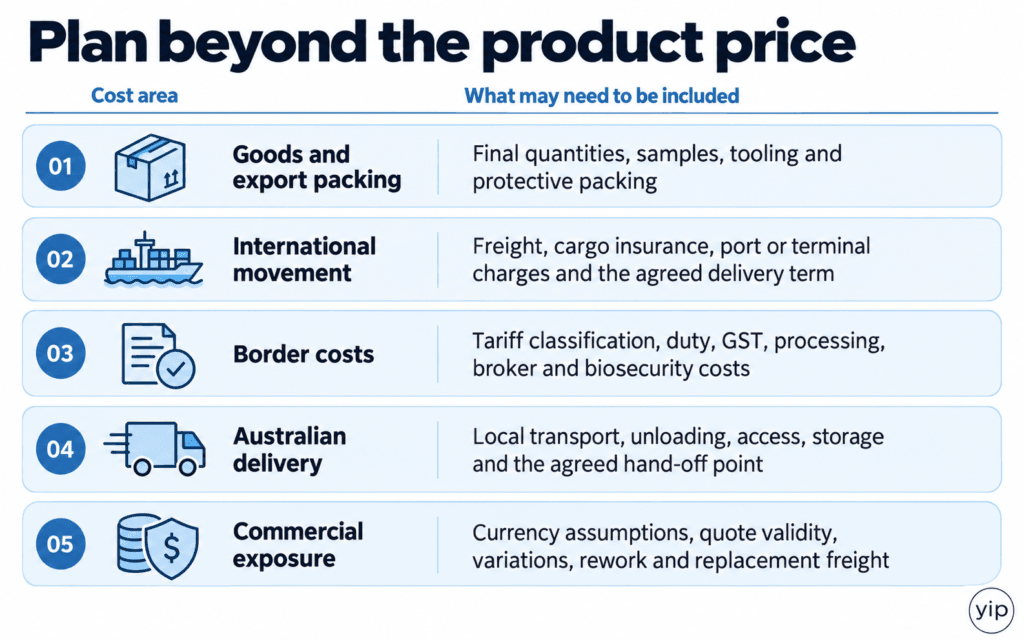
The commercial picture needs to extend beyond the factory quotation. Australian Border Force explains that imported goods are generally liable for duties and taxes unless an exemption or concession applies. Its cost of importing goods guidance outlines the main areas importers need to check.

The applicable treatment depends on the goods, tariff classification, origin, value and import arrangement. A project should not use a generic duty percentage without checking the actual product. YIP can coordinate the supply and logistics information, while specialist customs advice and declarations should be handled by the appropriate importing party or licensed customs broker.

The delivery plan also needs a named endpoint and hand-off. Confirm the delivery address, access limits, unloading method, storage conditions, damage-reporting process and the person who will receive the goods. YIP’s Client Terms explain that the selected delivery mode determines what handling is included and what the client must arrange.

The milestones that keep a project moving

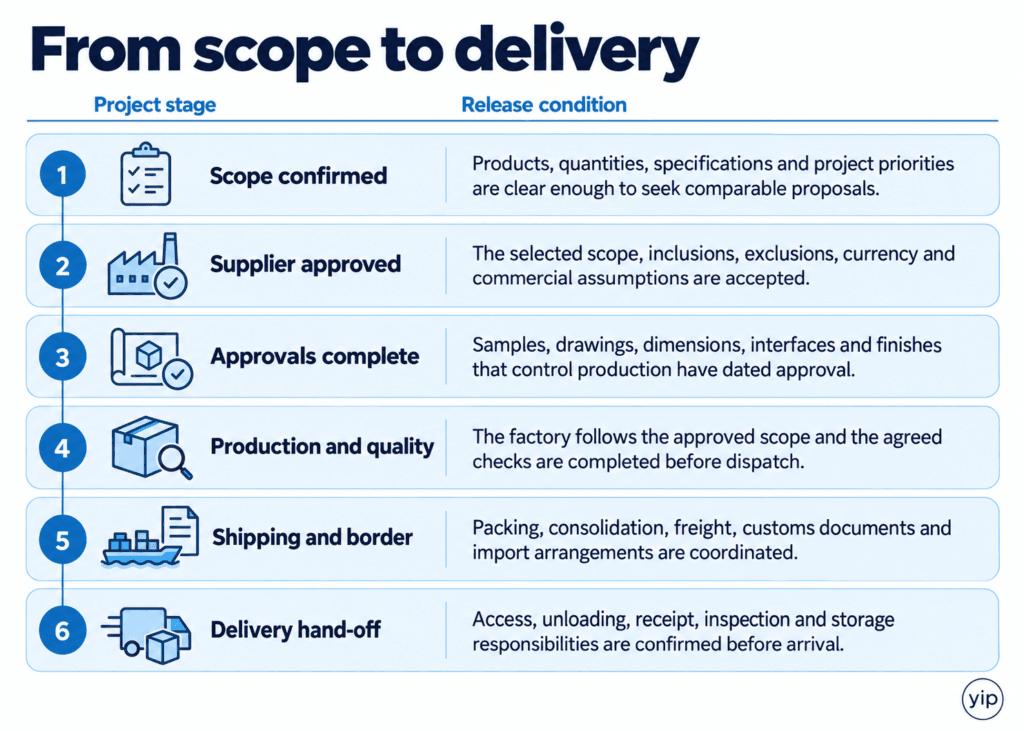
Managed procurement works best when each stage has an explicit output and approval point:

These milestones give the client, designer and builder a shared record of what has been decided. They also expose a change at the stage where its effect can be assessed. If an appliance changes after joinery drawings are approved, or site dimensions move after a window schedule is released, the team can decide whether to revise the order or adjust the surrounding work.

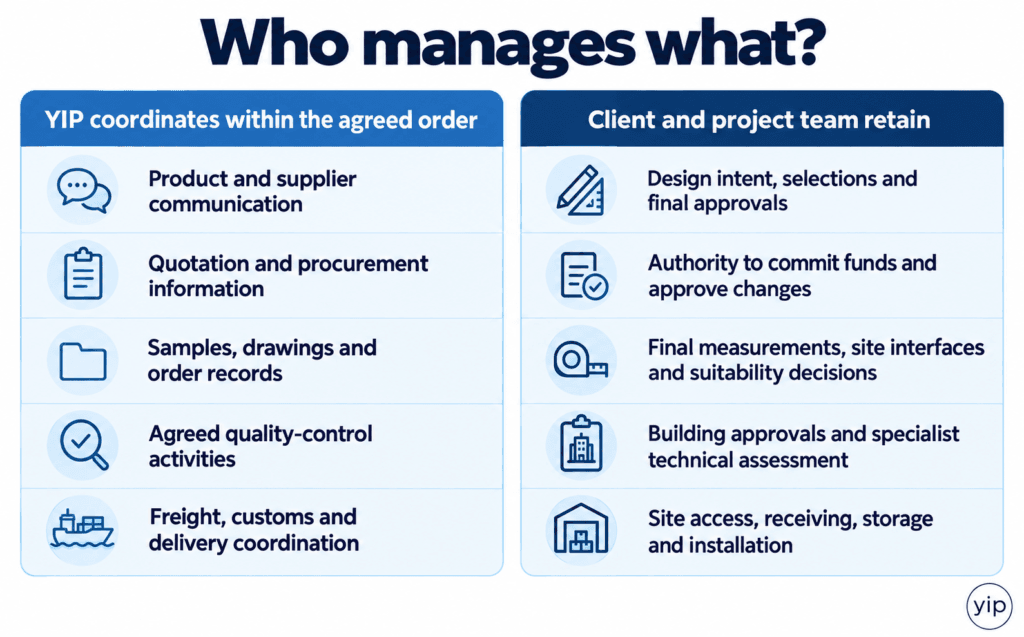
What YIP manages and what the client team retains

One coordination partner does not mean one party makes every decision. At a minimum, the project needs an authorised decision-maker, current drawings and schedules, a clear selection process, confirmed site information, programme dates and a receiving contact.

The practical test is simple: if the factory asks about size, finish, location or integration, the project needs a source of truth that can answer it. YIP can manage the procurement path around that answer. It cannot responsibly invent it.

Frequently Asked Questions

It means coordinating the agreed supply process from the initial product brief through supplier communication, quotation, approvals, production records, quality checks, freight, customs and delivery. The exact service included should always match the accepted YIP order or agreement.

A useful starting package includes the product list, quantities, drawings or reference images, dimensions, preferred finishes, delivery location and target timing. Existing specifications or comparison quotes can also help the team identify gaps and assess whether managed sourcing is suitable.

No single document applies to every product or project. YIP can coordinate available specifications and supporting documents for the agreed order, but the required evidence depends on the product, intended use and jurisdiction. The client team should involve the relevant certifier, regulator or qualified professional where specialist assessment is required.

No. YIP provides products and logistics services, not construction or installation. Site measurement, installation and trade-specific approvals remain with the client and its appointed professionals, as outlined in YIP’s Client Terms.

It depends on the product and project, but urgent replacement items and very small quantities are often better suited to local supply. Managed sourcing is generally more practical when the scope is defined, the quantities justify the coordination and the programme allows time for approval, production and freight.

If you have a defined product list or schedule, send YIP the quantities, drawings or reference images, preferred finishes, delivery location and target timing. The team can assess whether a managed procurement approach suits the project. Start a project enquiry, or review YIP’s information for builders and developers, architects and designers and owner-builders.

Read More