

Request Pricing
9257f6a2037ee6c574b12d93ac88fad3b951fb8d (1)

From Specification to Site: YIP’s Factory-to-Site Procurement Workflow

Key Takeaways
  • A usable brief anchors supplier comparison, approvals, production, quality checks and delivery.
  • Your Import Partner coordinates the agreed supply scope through factory quality control, freight, customs and delivery.
  • The client team retains design decisions, final approvals, site interfaces, receiving and installation.
  • Standards, registrations and certifications should be confirmed for the exact product before ordering.
  • Each hand-off needs a clear decision-maker, recorded approval and realistic site receiving plan.
Two workers handle a package in a spacious warehouse surrounded by shelves stocked with boxes and products.

Direct sourcing does not begin with a factory search or end when a container leaves port. For project teams considering factory-direct sourcing in Australia, a building-product order must carry the same agreed specification through supplier selection, quotation, approvals, production, inspection, freight and delivery. When one of those hand-offs is vague, the problem usually appears later as an unpriced variation, an unsuitable product, a delayed shipment or goods arriving before the site can receive them.

YIP manages procurement as a project workflow for builders, designers and qualified owner-builders. The service is not an installation service, and it is not a courier or freight-only arrangement. Its role is to coordinate the supply chain from the agreed product scope through to delivery, while the client team retains the project decisions and site responsibilities that sit outside that supply scope.

The sequence below explains the decision gates. The exact documents, product requirements and delivery plan depend on the project and the products being sourced.

Core principle: Every hand-off should preserve the approved product scope and make it clear who can approve a change.

The workflow begins with a usable brief

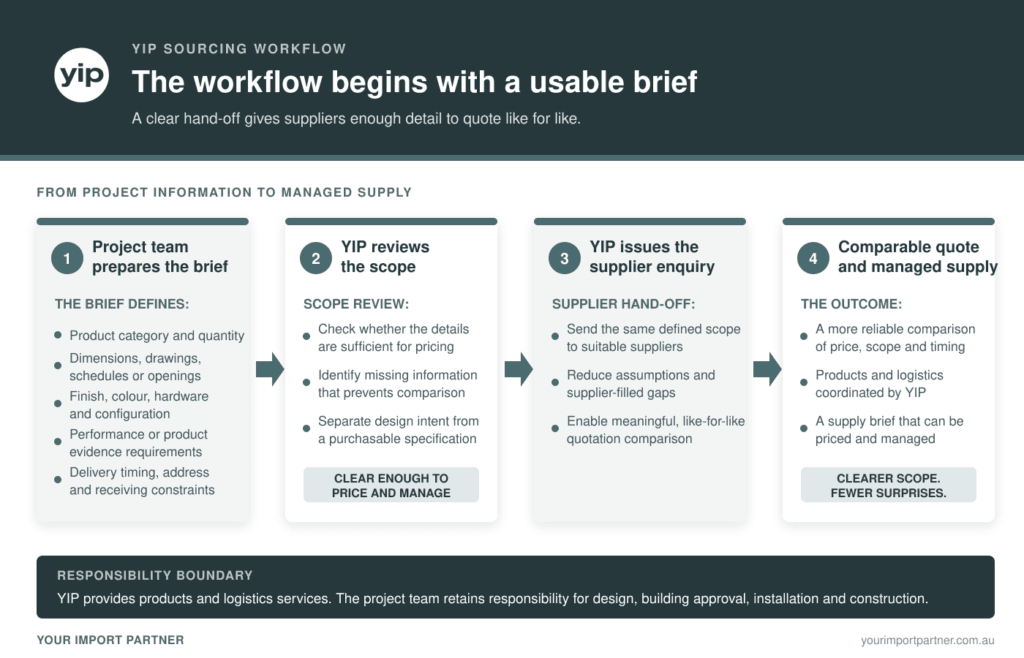
The first hand-off is between the project information and the supply enquiry. Before a supplier can provide a meaningful quotation, the products need enough definition to compare like with like. That means identifying the category, quantities, sizes, finishes, performance requirements where applicable, delivery location and the date the site needs the goods. The products YIP currently sources can help frame the initial category list, but the project brief still needs to define the exact requirement.

A usable sourcing brief normally identifies:

  • Product category and quantity
  • Dimensions, drawings, schedules or opening information
  • Finish, colour, hardware and configuration
  • Performance or product-evidence requirements were applicable
  • Delivery address, target period and receiving constraints.

This is where project teams need to separate a design intention from a purchasable specification. A finish reference without a size schedule, a window concept without opening information, or cabinetry without an approved layout leaves a supplier to fill in the gaps. That may produce a low initial figure, but it does not produce a reliable comparison.

The client and design team provide the scope, drawings, selections and any project specific requirements. yip reviews the information needed to take the enquiry to suitable suppliers and identifies missing details that prevent a comparable quote. A scope review does not transfer design, building approval or installation responsibility to the procurement partner. YIP’s Client Terms confirm that it provides products and logistics services, not installation or construction. The review makes the supply brief clear enough to price and manage.

Supplier selection only works when quotations match the same scope

Factory-direct sourcing is sometimes described to remove intermediaries. That misses the part that affects the project’s outcome: the factory still needs to be suitable for the product, the required specification and the order size.

A trade account with a merchant and a trade account with an importer can carry a forty percent difference on the same product, and both will be described to you as trade pricing.

The only way to know is to compare landed cost, which we come back to shortly.

YIP says it works with verified overseas manufacturers and manages sourcing as part of a wider procurement service. The supplier stage should produce a shortlist and quotations that can be compared against the same documented scope. The product description, quantity, inclusions, exclusions, price basis and delivery assumptions need to sit beside each other. A quote cannot be compared properly if one supplier has allowed for hardware, packing or a particular finish and another has not.

The decision gate is a client decision. The client team needs to approve the selected product and the commercial scope before an order is placed. Yip can coordinate supplier communication and quotation comparison, but it should not be treated as the party that chooses the design outcome or authorises expenditure for the project.

Samples and drawings turn the selected product into an orderable item

Once a supplier and product direction are selected, the project moves from an indicative quote to approval material. Depending on the category, that may include samples, shop drawings, schedules, finish references, hardware selections, dimensions, opening details or packaging requirements.

This is the point at which a project can still correct an interpretation before production starts. The client, architect, designer or builder needs to check the material against the intended use and the surrounding work. A tap set needs to suit the plumbing design. A window system needs to relate to the opening and glazing requirements. Cabinetry needs to agree with the kitchen layout, services and appliance information. The exact approval task changes with the product, but the principle does not: production should follow the approved specification, not an assumption made during quoting.

YIP coordinates the supplier side of those approvals. Its architect and designer supply pathway describes this as turning selections into a supply-ready package. The project team provides timely decisions and confirms the information that only it can own, such as final finishes, dimensions, site interfaces and programme requirements. Delayed or revised approvals can change the production start, so they need to be treated as programme decisions rather than administrative tasks.

A purchase order starts production, not the end of project control

After approvals, the order needs a clear production record. The essential point is continuity: the item being made must be traceable back to the approved product, drawing or schedule. Where a project has several categories, each supplier also needs to understand the information that affects its own product, packing and readiness date.

YIP describes its service as managing sourcing, logistics, quality control and compliance from specification through to site delivery. In practical terms, production coordination needs scheduled checks and a clear route for a supplier question or change. A factory cannot resolve an ambiguous finish, dimension or interface by itself without creating a project risk. The question needs to be returned to the person who can approve the change, then be recorded before work continues.

The approval gate here is simple but consequential. If a change affects the agreed specification, price, timing or related trades, the client team needs that change before the product proceeds. A procurement workflow controls that hand-off. It does not make an unapproved variation disappear.

Inspection, documentation and packing protect the next hand-off

Quality control sits before shipment because a defect discovered after arrival has fewer practical options. yip publicly states that orders are inspected at the factory against the project specification before shipping. Its builder and developer information describes factory inspection as part of its managed supply process, while its owner-builder says clients receive photos and sign off before shipment.

The inspection task must follow the agreed scope. It can check the product against the approved information, but it cannot prove that a product is suitable for an undefined site condition or replace the checks required from the relevant designer, builder, certifier or trade. The documents needed for a particular product can also vary. Where project, product or regulatory requirements call for specific evidence, those requirements need to be identified before ordering so the supplier has a defined deliverable.

Product evidence should be matched to the exact category. Australian product safety guidance states that suppliers, including importers, must comply with any relevant mandatory standards. For regulated taps and showers, confirm the applicable WELS registration and WaterMark certification before supply or installation. The required evidence should be resolved before the purchase order, not after the goods arrive.

Packing has the same practical purpose. The delivery team needs to know what is in each package, what requires protection and how the goods will be handled when they reach Australia and then the site. Multi-category orders need that information to travel with each supplier’s goods. Otherwise, consolidation makes later identification harder rather than easier.

Freight and customs are coordinated around the product and the site

After goods are ready for shipment, the workflow moves from factory control to international and local logistics. yip states that it manages customs clearance, freight and site delivery as part of its import service. That coordination is most useful when the shipping plan is connected to the production status, packing information and site programme.

For a project with more than one product category, consolidation can reduce the number of separate deliveries, but it also creates a dependency: the shipment cannot be ready until the included goods are ready and documented. That needs to be decided against the project programme. A builder may prefer one coordinated arrival for a fit-out stage or may need a category released earlier because another trade cannot proceed without it. The right choice depends on programme sequence, storage capacity, access and the condition of the site.

Customs and duty costs also belong in the supply plan, but their treatment depends on the product classification, origin, value and transaction details. The Australian Border Force import declaration guidance explains that declarations, duties, taxes, charges, permits and biosecurity requirements vary with the goods and consignment. This article does not calculate duty or give customs advice. The procurement scope should identify the importer, any licensed customs broker involved and the party responsible for information needed to complete the import documentation.

Site delivery requires a prepared receiving plan

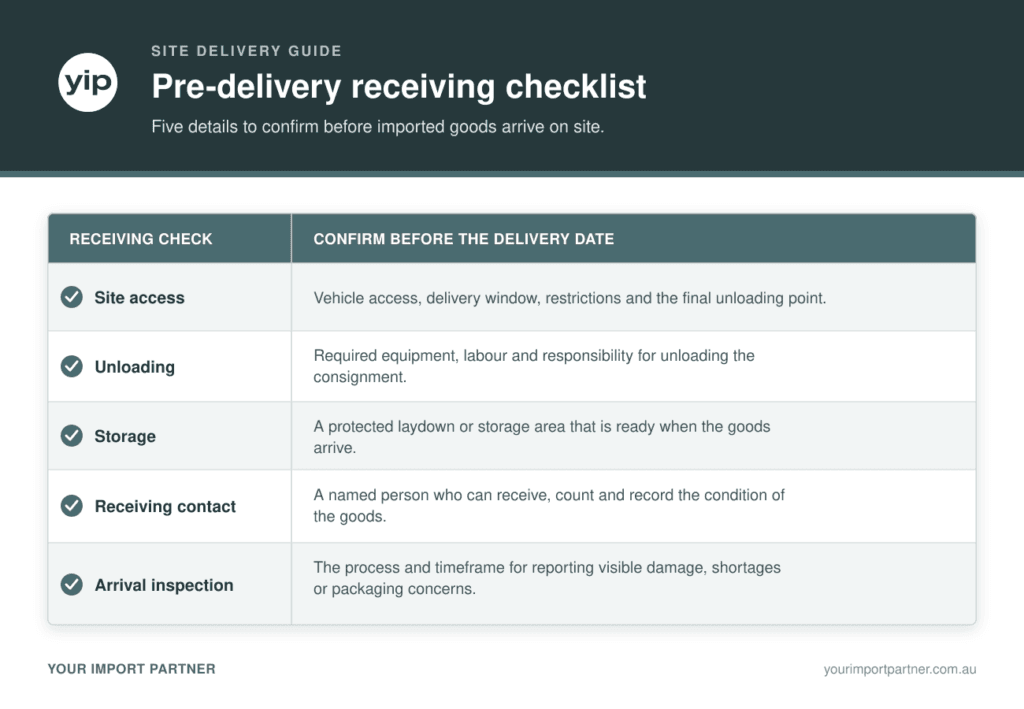
Factory-to-site is a supply-chain sequence, not a promise that goods can be unloaded anywhere or installed by the procurement partner. Before delivery, the builder or owner-builder needs to confirm that the site can receive the consignment: access, unloading arrangements, safe storage, room allocation, sequencing and the person who will check goods on arrival.

A pre delivery checklist table.

This hand-off is particularly important for pre-constructed cabinetry and other finished products. Delivery timing must work with the readiness of the relevant area, not merely with the arrival of the shipment. The builder still coordinates the site, trades, installation and any work needed before products can be fitted.

yip describes its role as coordinating delivery to site and provides logistics coordination covering customs, freight and last-mile delivery. The owner-builder supply pathway explains how that managed delivery fits a client-led project. YIP’s Client Terms distinguish between Basic Pallet Delivery and White Glove Delivery, so access, handling, room placement and unpacking must reflect the mode included in the quotation. Treat indicative timing as planning information, not a guarantee of a particular site date.

The delays that matter are usually unresolved decisions

Freight disruption can change a programme, but many avoidable delays begin earlier. An incomplete specification prevents comparable quoting. A late finish decision can hold drawings. A changed appliance model can alter cabinetry. A missing delivery plan can leave goods ready before the site has storage or access. Each issue belongs to a particular decision-maker, which is why the workflow needs visible approval gates rather than a long chain of informal messages.

For a managed project, the useful question is not simply whether a product can be imported. It is whether the team can define the product, approve it, receive it and install it in the sequence the job requires. yip can coordinate the supply side of that sequence. The project team needs to bring a usable brief, timely approvals and a site plan that matches the delivery arrangements.

If you are planning a multi-category building-product order, start with the products that will affect the programme. Prepare the product list, quantities, drawings or reference images, finishes, delivery location and target timing, then start a project enquiry with yip before supplier quotations are requested. For related sourcing guidance and case studies, browse YIP’s articles and guides.

Frequently Asked Questions

YIP coordinates the agreed product supply scope, including supplier communication, quotations, factory quality control, freight, customs clearance and delivery. The client team remains responsible for design decisions, approvals, site preparation and installation.

A useful sourcing brief should include product categories, quantities, dimensions, drawings, finishes, performance requirements, delivery location and target timing. Providing clear information allows YIP to obtain quotations that can be compared on the same scope.

No. YIP provides procurement and logistics coordination rather than construction or installation services. Installation, site management and coordination with relevant trades remain the responsibility of the builder, owner-builder or project team.

YIP coordinates factory inspections against the approved product specifications before the order is shipped. Depending on the product, this may include checking quantities, finishes, dimensions, packaging and supporting documentation.

Yes. YIP can coordinate multiple product categories and, where appropriate, consolidate them into a planned shipment. The best approach will depend on production schedules, site requirements, storage capacity and whether certain products are needed earlier than others.

Read More