

Request Pricing
9257f6a2037ee6c574b12d93ac88fad3b951fb8d (1)

Importing Building Materials from Asia to Australia: A Managed Project Guide

Key Takeaways
  • Managed importing suits a defined product package, realistic quantities and enough time for approvals, production and freight.

  • Compare suppliers against the same drawings, finishes, quantities, inclusions and delivery assumptions.
  • Confirm the Australian requirements for the exact product and intended use before placing the order.
  • Budget for the full path to the agreed Australian delivery point, not only the factory invoice.
  • Use recorded approvals at scope, supplier, production, shipment and delivery stages.
  • YIP coordinates agreed products and logistics. It does not provide construction or installation services.
Construction site with building materials being lifted into place, illustrating managed import logistics for builders

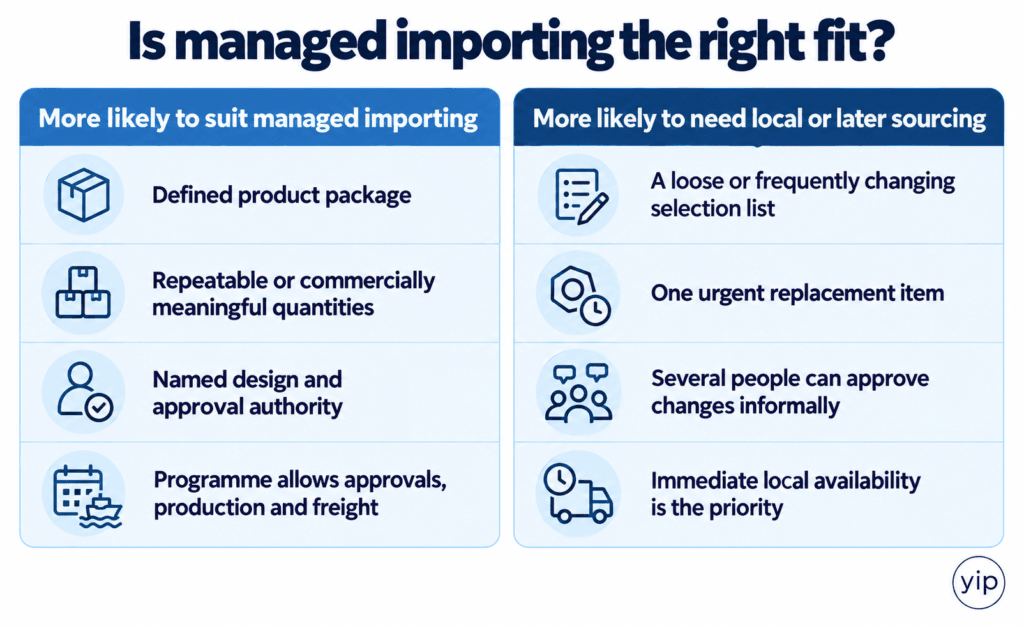
Importing building materials from China can work well for a project with enough defined scope to justify the coordination. It is a poor fit for a loose product list, late selections or a single price comparison. The factory price is only one number in a chain that also includes specification, approval, production control, border clearance and delivery to a site that is ready to receive the goods.

For a builder or developer, the first decision is not which marketplace to search. It is whether the project team can define what is being bought before a factory starts pricing it. A package of selected fixtures, finishes and made-to-order products can arrive as one procurement programme, but each category has different drawings, finishes, lead times, packaging and site interfaces.

The most reliable approach is to treat the purchase as project procurement. Lock the scope, confirm the applicable requirements for each product, approve the production information, then manage the shipment against a delivery plan. A low unit price cannot repair a wrong finish, a missing document or a container delivered before the site can unload it.

Scope note: In this guide, building materials means selected fixtures, finishes and made-to-order products within YIP’s sourcing scope. YIP supplies products and logistics services, not construction or installation.

Direct importing suits a defined project, not an unfinished selection schedule

Direct import generally makes more sense when a project has repeatable quantities, clear design authority and enough time to resolve details before manufacture. A multi-category fitout may justify supplier coordination and consolidated freight because the work has a common programme and a single delivery objective.

It becomes harder when cabinetry dimensions are still moving, appliance models have not been selected, finishes are being chosen from photographs, or several people can approve changes without a clear sign-off point. In those conditions, a factory can produce accurately to an incomplete instruction. The resulting problem sits in the project, not in the purchase order.

Before seeking prices, nominate who can approve drawings, samples, substitutions and delivery dates. That person needs a current set of architectural, joinery and services information, together with a schedule that identifies quantities, dimensions, finishes, hardware, glazing, electrical requirements where relevant, and the room or elevation where each item belongs. YIP’s builder and developer pathway explains how this information supports a managed supply process.

Build a scope that a factory can price without guessing

Factory-direct sourcing is sometimes described to remove intermediaries. That misses the part that affects the project’s outcome: the factory still needs to be suitable for the product, the required specification and the order size.

A useful procurement schedule does more than list product names. It identifies the item, quantity, specification reference, finish, target approval date, production lead time, packaging requirement, delivery location and the person responsible for each decision. For custom products, attach the drawings that control dimensions and interfaces rather than relying on a written description such as ‘similar to sample’.

A minimum pricing package should include:

  • Product, quantity and specification reference
  • Dimensions, drawings and package interfaces
  • Finish, colour, hardware and configuration
  • Required product evidence or project documentation
  • Packing, delivery location, target timing and decision owner

That level of definition protects the quote comparison. Two factories may both quote a vanity, for example, while allowing for different carcass materials, drawer hardware, stone cut-outs, basin positions, packaging or installation exclusions. The lower figure may describe a different item.

Break the scope into packages only where the commercial and technical interfaces are clear. Joinery drawings may need appliance cut-out information. Window and door suppliers need opening sizes, glass selections and hardware positions. A supplier of loose fixtures needs the final quantities and the delivery sequence. When packages share a dependency, record it in both supplier instructions rather than assuming one factory will discover it.

Vet factories against the package, then compare like with like

Factory selection begins with capability for the specific package. The relevant questions vary with the product. A factory making standard furniture may not be the right supplier for custom joinery drawings. A window supplier may have a product range that does not match the required opening, glazing or hardware configuration.

Ask suppliers to respond to the same scope and request the same commercial information from each: product specification, quantity, unit price, tooling or sample costs, minimum order quantity, production period, payment stages, packing method, delivery term, quote validity and exclusions. Then place the quotes beside the schedule and mark every variance. Do not resolve a missing inclusion by assuming it is included in a total.

Delivery terms also need to be stated, using an agreed Incoterm where appropriate. The project team should understand the named place, the point at which responsibility changes, and whether the quoted amount includes international freight, insurance, export arrangements or Australian charges. An Incoterm allocates specified delivery responsibilities. It does not replace a written scope, a compliance review or a landed-cost calculation.

If a quote assumes preferential duty under the China-Australia Free Trade Agreement, confirm that the goods meet the relevant origin rules and that acceptable origin documentation will be available. The DFAT ChAFTA guide explains that preferential rates apply only to qualifying originating goods.

Samples and drawings are production controls

Samples, shop drawings and finish boards serve different purposes. A material sample can confirm colour, sheen and texture, but it does not prove a cabinet dimension or hardware position. A drawing can show dimensions and interfaces, but it may not settle the appearance of a veined stone slab or a painted finish. The approval record needs both where the product requires both.

Put a document revision number and approval date on each controlled item. Once a factory starts production, changes can affect cost, programme, completed components and adjacent packages. The project team needs one approved version, not a chain of email comments that leave the factory to decide which instruction governs.

For custom joinery, the practical approval set often includes room layouts, elevations, cabinet dimensions, door and drawer fronts, hardware, handles, appliance clearances, benchtop details and finishes. For windows and doors, it may include opening sizes, frame profiles, glass, hardware, handing and installation interfaces. The list changes with the package, but the discipline does not: approve the information that determines what will be made before production begins. YIP’s architect and designer pathway describes how selections can be turned into a supply-ready package.

Confirm Australian requirements before an order is placed

‘Australian compliant’ is not a useful procurement instruction on its own. Requirements depend on the product, its intended use, the building and the state or territory approval pathway. Product safety requirements, building requirements, electrical rules, labelling, biosecurity and contract specifications can each apply in different ways.

Start with a product-by-product compliance register. For each item, record its intended use, the project requirement or authority that applies, the evidence needed, who will assess it and the date it has to be resolved. Where the project requires a particular test, certificate, rating or installation instruction, identify the exact product version and configuration the evidence covers. A document for a similar product may not cover a changed material, glass type, size or hardware set.

Australian product safety rules apply to suppliers, including importers, where a mandatory standard or ban covers the goods. For regulated taps, showers and other water-using products, check whether WELS registration and other product-specific evidence are required for the exact model.

Timber products and timber packaging must meet the applicable Biosecurity Import Conditions. Importers of regulated timber products should also check the illegal logging due diligence requirements that apply to their goods and keep the required records.

The importation of engineered stone benchtops, panels and slabs has been prohibited since 1 January 2025. Safe Work Australia notes that resin-free sintered stone can fall outside that prohibition, so confirm composition and classification rather than relying on a trade name. See the engineered stone ban guidance.

Important: This guide provides procurement context, not customs, legal, certification or building-compliance advice. Use the relevant licensed, regulatory and project professionals for the actual product and project.

Inspect the work and protect the load before shipment

Quality control works best when it follows the approved scope. An inspection checklist should draw from the signed drawings, finish approvals, quantities, visible quality criteria, function checks and packaging requirements. A generic ‘inspection passed’ statement does not show whether the factory checked the details that matter to the package.

The timing depends on the product. A review before production can catch a drawing discrepancy. An in-process check may matter where an error will be concealed by later assembly. A pre-shipment inspection can compare finished goods, quantities, labelling and packing against the approved records before the container is sealed.

Packing is part of the product outcome. Record how fragile surfaces are protected, how cartons are labelled, which room or package receives each item, and whether the site needs lifting equipment, a forklift or weather-protected storage. A container can clear the border and still create a site problem if the goods cannot be identified, moved or stored safely after arrival.

Price the landed position, not only the factory invoice

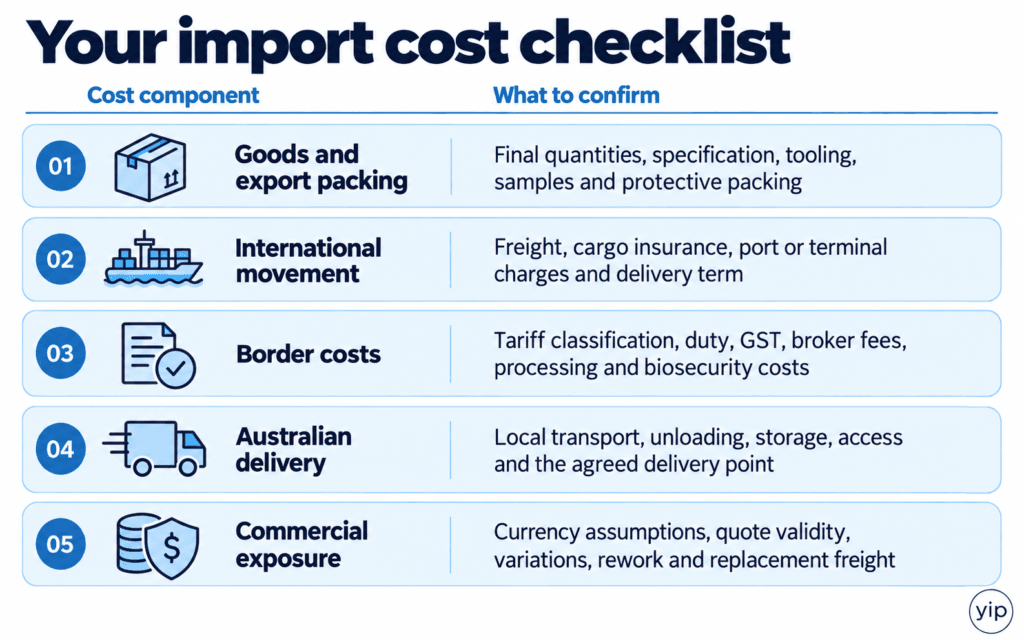
The landed cost is the combined cost of getting a defined package to its agreed Australian delivery point. The applicable components depend on the goods, delivery term, origin, consignment and clearance route.

Duty is not a flat percentage for all building products. Imported goods need a tariff classification, and concessions or preferential tariff treatment can have their own conditions. Confirm the classification, origin evidence and applicable rate for the actual goods before treating a supplier estimate as a project cost.

For a taxable importation, GST is generally 10% of the value of the taxable importation. Australian Border Force explains that this value includes the customs value, customs duty, transport and insurance to Australia, and wine equalisation tax where applicable. Confirm the current calculation and transaction details using the ABF GST guidance. Any input-tax-credit treatment is an accounting matter for the importing entity and its adviser.

For consignments over A$1,000 that are cleared into home consumption, an Import Declaration is generally required and applicable duties, taxes and charges must be paid before release. Only the owner of the goods or a licensed customs broker can submit an import declaration to enter goods for home consumption.

The practical control is a live landed-cost sheet tied to the final scope. Update it when quantities, packing volumes, freight assumptions, tariff advice, delivery terms or local transport change. That makes it possible to compare the project budget with the actual purchase decision before funds are committed.

Freight and site delivery need one sequence

Freight is usually discussed after the order, but the site delivery plan needs to exist before the shipment is booked. Confirm the port, customs clearance route, delivery address, site access, unloading method, storage location, sequencing by trade and the person who will accept the goods. A container delivery may require a clear booking window, suitable vehicle access and immediate unloading arrangements. Loose packages may need a different plan.

Match shipment timing to the point at which the project can protect the goods. Cabinetry delivered before wet trades, painting or floors are complete can be exposed to damage and double handling. Windows delivered before openings are ready can occupy valuable space or require separate storage. There is no universal lead time because product categories, approvals, production capacity, freight services and site readiness all change it.

Customs clearance is one milestone in the delivery plan, not the end of the procurement work. The project still needs the right packages delivered to the correct location with a record of any shortage, damage or variance. Delivery responsibilities should match the agreed service and YIP’s Client Terms, including the selected delivery mode, site access and receiving responsibilities.

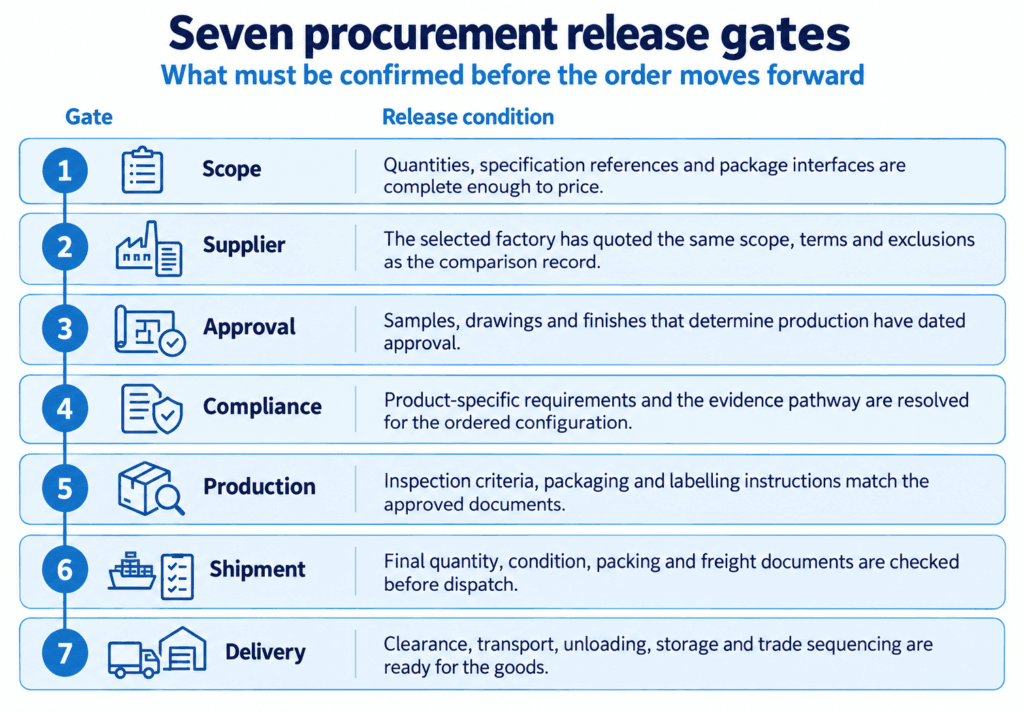
Use stage gates to stop small gaps becoming expensive changes

An import programme becomes easier to control when each stage has a specific release condition:

Those gates do not remove normal project risk. They give the project team a point to stop, test the information and correct a discrepancy before it becomes a container, a customs entry or an installation problem.

YIP’s managed sourcing and logistics service can coordinate the agreed supply process across specification, supplier communication, quality control, customs, freight and delivery. The client and its appointed professionals remain responsible for design decisions, product suitability, site interfaces and installation. Qualified owner-builders can also review YIP’s owner-builder pathway.

Frequently Asked Questions

YIP coordinates the agreed product supply scope, including supplier communication, quotations, factory quality control, freight, customs clearance and delivery. The client team remains responsible for design decisions, approvals, site preparation and installation.

A useful sourcing brief should include product categories, quantities, dimensions, drawings, finishes, performance requirements, delivery location and target timing. Providing clear information allows YIP to obtain quotations that can be compared on the same scope.

No. YIP provides procurement and logistics coordination rather than construction or installation services. Installation, site management and coordination with relevant trades remain the responsibility of the builder, owner-builder or project team.

YIP coordinates factory inspections against the approved product specifications before the order is shipped. Depending on the product, this may include checking quantities, finishes, dimensions, packaging and supporting documentation.

Yes. YIP can coordinate multiple product categories and, where appropriate, consolidate them into a planned shipment. The best approach will depend on production schedules, site requirements, storage capacity and whether certain products are needed earlier than others.

Read More