Request Pricing
9257f6a2037ee6c574b12d93ac88fad3b951fb8d (1)

How to Choose a Trade Supplier for Building Materials in Australia

A builder’s guide to the four supply routes, what each one really costs, and the questions that separate a supplier from a reseller.
Key Takeaways
  • Most businesses that call themselves a trade supplier are resellers holding local stock, so a trade account still buys you in at somebody else’s margin.
  • There are four realistic supply routes for an Australian builder. Retail, a trade account, online, and managed direct import. Each trades cost against speed and control.
  • A builders discount is calculated off an inflated recommended price, so thirty percent off can still sit well above a fair landed cost.
  • Landed cost is the only number worth comparing. It includes freight, duty, GST, port charges, delivery to site and the cost of rework.
  • Prime cost items and provisional sums are almost always the imported categories, which is why supply choice hits your contract before it hits your margin.
Warehouse_stocks

Sourcing is the quietest margin leak on an Australian build.

It almost never appears as a line item you can point at in a variation.

It shows up instead as a kitchen package that cost twenty three thousand dollars when the same specification, the same finishes and the same tolerances could have landed for fourteen.

On a single mid range residential project, the gap across cabinetry, stone, tapware and fixtures can exceed sixty thousand dollars.

Across a pipeline of projects it stops being a purchasing problem and becomes a structural one.

This guide covers the four ways builders buy construction supplies in this country, what each route actually costs once everything is counted, and how to work out which one suits the way you build

A managed sourcing option for Australian builders

If you are comparing trade suppliers because you want better control over material costs, Your Import Partner provides another option beyond buying through traditional merchants, distributors and showrooms.

We help Australian builders, developers and design professionals source directly from manufacturers across categories such as cabinetry, stone, tapware, fixtures and other building products. Instead of managing factories, freight, customs, quality control and delivery separately, the process is coordinated through one sourcing partner.

The goal is not simply to find a cheaper unit price. It is to give you visibility over the landed cost, product specification, quality control and delivery programme before you commit the project.

If you already have an upcoming build or project schedule, tell Your Import Partner what you need and compare the sourcing route against your current supplier pricing before making a decision.

What a trade supplier actually is, and what it is not

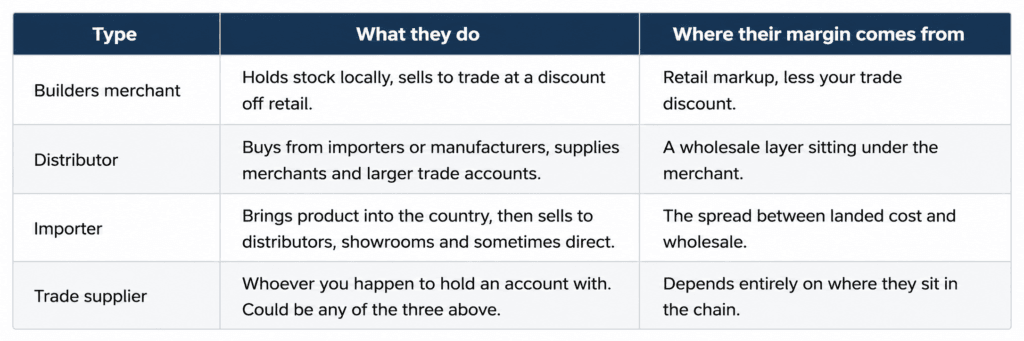
These four terms are often used interchangeably, but they represent very different positions in the supply chain. Understanding the difference matters because each one adds its own layer of cost, and ultimately affects what you pay.

A trade account with a merchant and a trade account with an importer can carry a forty percent difference on the same product, and both will be described to you as trade pricing.

The only way to know is to compare landed cost, which we come back to shortly.

The four ways builders buy construction supplies in Australia

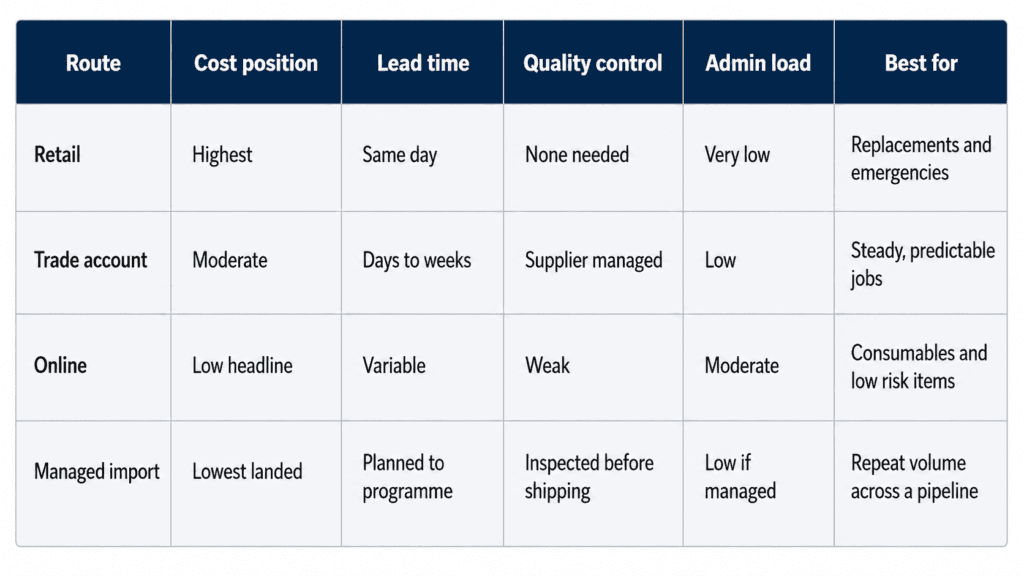
Most builders will use more than one supply route across a project. The real question is which route should carry most of your spend — and which ones are better kept for specific situations?

1. Retail and showrooms

Retail is usually the fastest and simplest option. It is also generally the most expensive.

If a client changes a tapware selection three weeks before handover, or you need a replacement item immediately, being able to walk into a local showroom and buy it that day has real value.

The trade-off is price. By the time an imported product reaches a showroom, it may already include importer, distributor and retail margins. For higher-value categories such as cabinetry, stone and tapware, those layers can add up quickly.

Best used for: urgent replacements, small quantities, last-minute selections and items where speed matters more than margin.

2. A trade account with a local distributor

This is the default route for many builders, and for good reason.

You get established pricing, access to local stock and a supplier you can call when something changes or a delivery does not turn up as expected. For day-to-day purchasing, that convenience is hard to replace.

What is less visible is how much margin has already been built into the price before your trade discount is applied. If the product has passed through an importer and distributor before reaching you, you are still paying for those layers — even after receiving a sizeable discount.

That does not make a trade account a bad deal. It simply means the discount percentage alone does not tell you whether you are getting the best project cost.

For builders running multiple projects, it is worth comparing that trade price against a direct sourcing model designed for builders and developers.

Best used for: regular purchasing, locally stocked products, smaller orders and materials you need on short notice.

3. Buying building supplies online

Online suppliers can look very attractive on price, particularly when you are comparing individual products.

For straightforward, low-risk items, they can work well. The difficulty starts when the product needs to arrive at a particular stage of the build, match an exact specification or be checked before installation.

A low online price can become much less attractive if a damaged or incorrect item turns into a returns process while your trades are waiting on site.

That is why online purchasing tends to make more sense for products where a delay, defect or specification issue will not hold up the programme.

Best used for: consumables, standardised products, accessories and other low-risk items.

4. Managed direct import

Managed direct import takes a different approach.

Instead of buying through several layers of the local supply chain, you source closer to the manufacturer while an import partner manages the parts that make direct sourcing difficult: supplier coordination, quality control, freight, customs and delivery.

For builders and developers with enough forward planning, this can reduce the amount of margin being absorbed between the factory and the project while still giving you someone accountable for the process.

The important word is managed.

Importing yourself can quickly become another job altogether. Specifications need to be confirmed, goods inspected, shipping coordinated, documentation checked and delivery timed around the build. The value of the model disappears if your team has to spend hours managing all of that themselves.

A managed model is therefore most useful when the partner takes responsibility for the supply chain rather than simply introducing you to a factory. You can see how this works in practice in the Kensington Apartment Kitchen case study, where cabinetry, stone and other materials were sourced and coordinated as part of the project.

For professional builders managing a pipeline of work, Your Import Partner’s builder and developer is structured around direct sourcing, factory quality control and delivery coordinated to the build programme. For people managing their own build, there is also a separate owner-builder sourcing with additional specification and import guidance.

Best used for: planned projects, higher-value material packages, repeat procurement and projects where the savings justify sourcing further upstream.

Comparison table showing retail, trade account, online and managed import building material supply routes by cost, lead time, quality control, admin load and best use.

What a builders discount is really worth

A trade discount is calculated off a recommended retail price.

That price is set by the supplier, and it is set high enough that a generous sounding discount still leaves the margin intact.

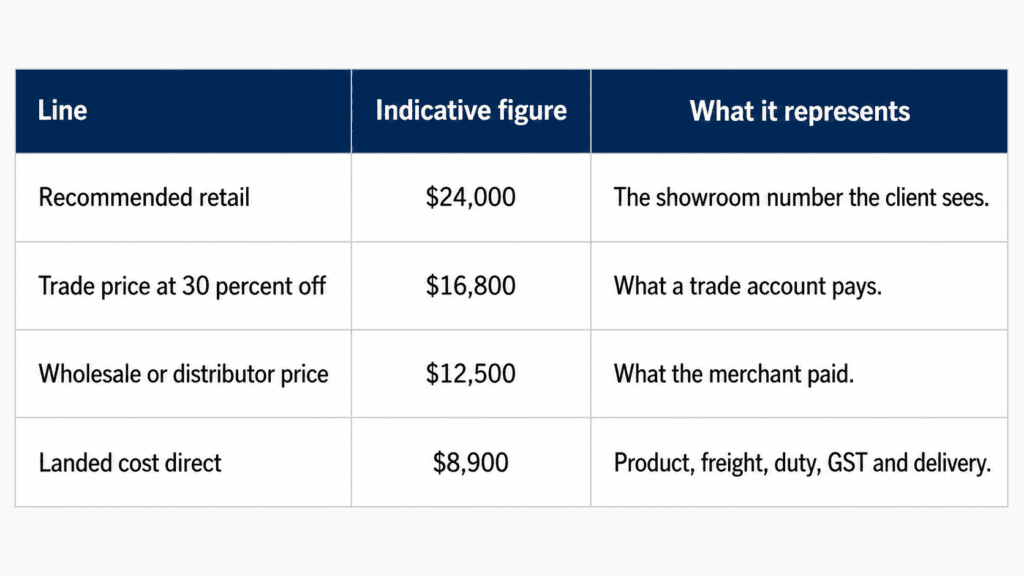
Here is the shape of it on a typical kitchen benchtop and cabinetry package.

Comparison of recommended retail, trade, wholesale and direct landed costs, showing indicative prices and what each pricing level represents.

Figures are illustrative and used to show the shape of the margin stack. Actual numbers vary by product, volume, exchange rate and tariff classification.

The trade discount is genuine.

It is also the smallest of the three reductions available on that package.

This is why comparing discounts between suppliers is close to meaningless.

You are comparing two different fictions unless you get to landed cost.

Landed cost is the only number worth comparing

Landed cost is what the product costs sitting on your site, ready to install, with nothing else to pay.

Most quotes do not show it, which is exactly why builders get surprised.

A complete landed cost carries every one of these lines.

  • Unit price at the factory or supplier gate.
  • International freight, whether that is a full container, a shared container or air freight.
  • Marine insurance on the shipment.
  • Import duty, which varies by tariff classification and country of origin.
  • GST on the taxable importation value.
  • Port, terminal and customs brokerage charges.
  • Inland freight from port to site, including any lift or access requirement.
  • Storage if the product arrives before the site is ready to receive it.
  • The cost of rework, replacement and programme delay when something arrives out of specification.

That last line is the one builders leave out, and it is often the largest.

A benchtop that arrives with a chipped edge does not cost you the price of the benchtop.

It costs you the crane, the trades standing around, the reorder lead time and the handover date.

For current duty rates and importation requirements, the Australian Border Force is the authority, and a licensed customs broker should confirm the classification for your specific product.

Prime cost items and provisional sums: where supply choice hits your contract

This is the part most sourcing articles skip, and it is the part that actually carries risk.

A prime cost item is an allowance in the contract for a product the client has not yet selected.

A provisional sum is an allowance for work where the scope is not yet fully defined.

In Australian residential contracts, the prime cost items are almost always the same categories: tapware, sinks, benchtops, tiles, appliances and sanitaryware.

Those are also, without exception, the imported categories.

The exposure runs two ways.

If the allowance is too low, the client faces a variation and you face the conversation.

If you carry the difference to protect the relationship, the margin comes out of your job.

Either way the supply decision made months earlier is what determined the outcome.

A supplier who holds pricing across a project pipeline changes the maths on this.

It is not just that the unit cost is lower.

It is that you can set a prime cost allowance you can actually hold to across four dwellings instead of guessing and hoping the market does not move.

This is the core of how we work with builders and developers, and it is the reason consistency matters more than a one off discount.

Eleven things to assess before you commit a project to a supplier

A strong supplier conversation should give you more than a price.

Use these eleven checks to understand where the commercial risk sits, what is actually included in the quote, and whether the supplier can support the project beyond taking the order.

1. Check how long the pricing is protected

Ask how long the quoted price remains valid and what happens if exchange rates, freight costs or supplier pricing change before the order is placed.

You want to understand whether the quote gives you genuine cost certainty or whether major components can still move later.

2. Find out whether the pricing can follow your project pipeline

Ask whether the pricing applies only to the current order or whether the supplier can maintain a consistent commercial structure across several upcoming projects.

For builders managing multiple dwellings or developments, consistency can be more valuable than securing the lowest price on one order.

3. Confirm whether delivery can follow your construction programme

Do not only ask for a lead time. Ask whether the supplier can coordinate delivery against your actual build stage.

Materials arriving too early create storage problems. Materials arriving too late can delay trades, installation and handover.

4. Understand the quality-control process before shipment

Ask who inspects the product, when the inspection happens and what specification or approved sample the product is checked against.

For imported or made-to-order products, finding a defect at the factory is significantly easier than discovering it once the shipment reaches site.

5. Establish who carries the cost when something is wrong

Clarify who pays for replacement product, freight and associated costs if something arrives damaged, incomplete or outside the approved specification.

Do not leave this until there is a problem.

6. Verify what compliance documentation is supplied

Confirm which certificates, specifications, material declarations and Australian compliance documents will be provided with the order.

The supplier should be able to explain what documentation applies to the category rather than simply saying the product is “compliant”.

7. Make sure the quote reflects the true landed cost

Ask who manages customs clearance, duty, GST, port charges and associated import costs.

A low factory price is not useful if substantial costs appear between shipment and delivery.

8. Clarify exactly where the supplier’s responsibility ends

Find out whether the quoted delivery is to the port, a depot, your warehouse or directly to the construction site.

Also establish who organises unloading, specialised access or lifting where required.

9. Assess how complicated communication will become

Ask whether you will have one person coordinating the order across product categories or whether you will need to manage multiple suppliers and account managers.

One accountable point of contact can substantially reduce procurement administration on larger projects.

10. Understand minimum orders and consolidation opportunities

Ask about minimum order quantities and whether cabinetry, stone, tapware, fixtures or other categories can be consolidated.

Consolidation can affect freight efficiency, delivery scheduling and the overall landed cost of the project.

11. Ask what they are prepared to guarantee in writing

Finally, ask which commitments around price, specification, inspection, delivery and replacement responsibility will appear in the agreement or order documentation.

This is where a supplier’s promises become commercially useful.

A good supplier should be able to give clear answers to most of these questions. A strong sourcing partner should also be able to take responsibility for coordinating many of them on your behalf.

Compliance and documentation you should have on file

Imported building products carry a documentation obligation, and the paperwork is far easier to collect at the time of order than eighteen months later during a defects claim.

At minimum, insist on the following.

  • Certificates of conformity for the relevant Australian Standards.
  • Full product specifications, including material composition.
  • Customs and import documentation for the shipment.
  • Material declarations, which matter more than ever since the engineered stone prohibition.
  • Warranty terms in writing, naming who honours them and for how long.

The engineered stone prohibition is the clearest example of why material declarations are not a formality. Safe Work Australia sets out what is banned and what is excluded, and a supplier who cannot tell you the resin content of a slab is not a supplier you want on a project.

When direct import makes sense, and when it does not

It would be easy to end this guide by telling you direct import always wins.

It does not, and pretending otherwise would waste your time.

Direct import works when

  • You have repeat volume across a pipeline rather than a single job.
  • You can plan a programme far enough ahead to order against build stage.
  • The categories are high value and high markup, such as stone, cabinetry, tapware and flooring.
  • You have a partner absorbing the freight, customs, inspection and delivery coordination.

Direct import does not work when

  • You need the product this week.
  • It is a single small job with no follow on volume.
  • The specification is still moving and likely to change after the order is placed.
  • Nobody on your side owns the process and no partner is managing it for you.

Most builders end up running a hybrid.

The pipeline categories go direct, the urgent and the odd go through a trade account, and the emergencies go retail.

That is a sensible position, and it is a long way from where most builders start.

Frequently Asked Questions

A builders merchant is a specific business model. They hold local stock and sell to trade at a discount off retail.

Trade supplier is a general label that any business in the chain can use, including merchants, distributors and importers.

The practical difference is how many margins sit between the factory and your invoice.

It depends entirely on the category and how far up the chain you buy.

On high markup categories such as stone, cabinetry and tapware, the difference between a showroom price and a landed direct cost is commonly in the range of thirty to sixty percent.

On commodity items with thin margins, the gap is much smaller and often not worth the coordination.

Doing it yourself is entirely possible, but supplier management, inspection, freight, customs and delivery can quickly become a significant procurement workload.

Builders who want the cost advantages of direct sourcing without managing the entire import process internally can instead use a managed sourcing partner. Your Import Partner coordinates sourcing, quality control, logistics and delivery for Australian building projects.

This is also why the sourcing model matters. Working with a partner that coordinates factory inspection before shipment reduces the chance of the problem first being discovered when the product reaches Australia. Your Import Partner incorporates sourcing and quality-control coordination into the managed import process rather than leaving the builder to deal directly with multiple offshore parties.

Yes. A managed sourcing partner can coordinate the process between the builder and overseas manufacturers, including product sourcing, specifications, factory communication, quality control, freight, customs and delivery.

This can be particularly useful for builders and developers purchasing higher-value categories across multiple projects who want access to direct sourcing without building an internal import and logistics function.

Your Import Partner provides this managed sourcing pathway for Australian builders, developers, owner-builders and design professionals.

Read More